(Intervista in lingua inglese)
Interview with Italy’s Ambassador to Bangladesh
‘Bangladesh-Italy trade stands at €2 billion; we want to increase it further’
‘Not everyone can go to Italy; we have to understand this reality’
Around 250,000 Bangladeshis live in Italy
10,000 Bangladeshis went to Italy for work in 2025; a similar number is expected this year
Around 500 Bangladeshi students went to Italy in 2025
Italy’s Ambassador to Bangladesh, Antonio Alessandro, has urged Bangladeshis to refrain from attempting to travel to Italy through irregular routes and instead make use of legal migration opportunities. He said around 10,000 Bangladeshi workers were able to travel to Italy through legal channels in 2025, and a similar number is expected this year. Italy contributes nearly 5 percent of Bangladesh’s total remittance inflows, amounting to around US$1.7 billion.
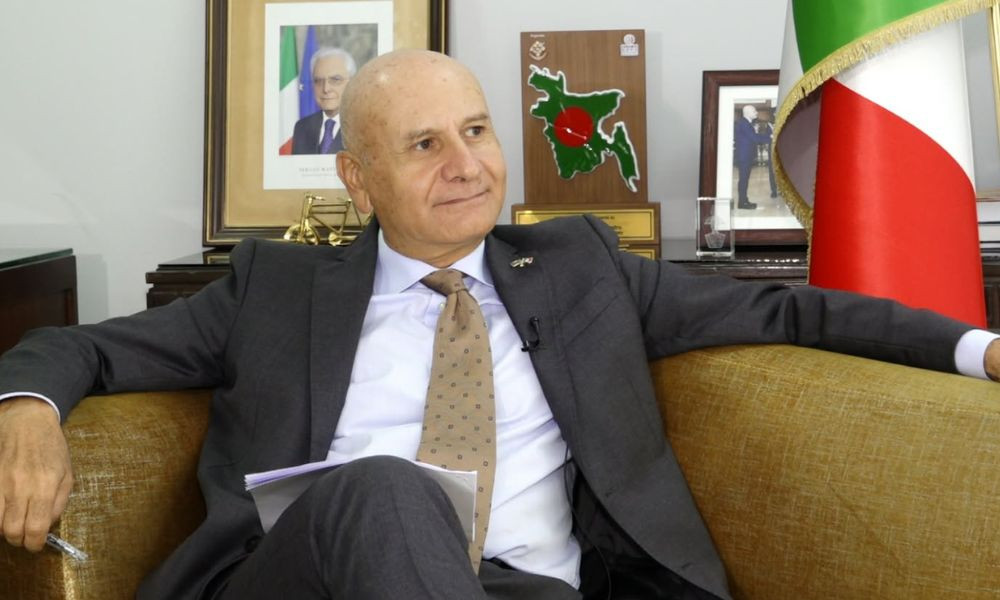
At the same time, the Ambassador said the future of Bangladesh-Italy relations is “very bright” in a wide range of areas, including migration, trade, the economy, culture, defence and education. Against this backdrop, Kaler Kantho’s Staff Reporter Abdullah Al Miraj interviewed Italian Ambassador Antonio Alessandro on migration, education, trade and various aspects of bilateral relations between Bangladesh and Italy.
Kaler Kantho: How has your experience in Bangladesh been over the past three years?
Antonio Alessandro: I have been in Bangladesh for more than three years now, and my experience has been fantastic. It has been a wonderful experience. My wife, who lives with me in Dhaka, and I have really enjoyed the atmosphere, the people and the friends we have made here. Everything has been going very well.
Kaler Kantho: How do you see the Bangladeshi community in Italy?
Antonio Alessandro: The Bangladeshi community in Italy is quite large. There are approximately 250,000 people of Bangladeshi citizenship or Bangladeshi descent. It is the largest Bangladeshi community in the European Union. One particular law of Italy, compared with other destination countries, is that family members of an initial migrant are allowed to join them later. There is also an opportunity to acquire Italian citizenship after a certain period. This makes foreign communities, including the Bangladeshi community, an integral part of Italian society.
It also means that migrants tend to stay for a long time and become part of our country. Therefore, they have to make an effort to integrate into new habits and a new culture. This naturally takes time and effort. Otherwise, there can be integration problems. There have been some limited cases of such problems in Italy, particularly in some small towns or villages where the Bangladeshi community has grown very rapidly. But apart from these limited cases, I would say the overall situation of the Bangladeshi community in Italy is very good and satisfactory.
The community makes an important contribution to the Italian economy, through its workforce as well as through economic activities. Many Bangladeshi entrepreneurs are now contributing to the vitality of the Italian economy.
At the same time, Bangladeshis living in Italy make an important contribution to Bangladesh through remittances. We can proudly say that approximately 5 percent of all remittances received by Bangladesh come from Italy. Last year, the amount was approximately US$1.7 billion. This is a significant amount of money, made possible by the hard work and commitment of Bangladeshis living in Italy. They certainly deserve to be recognised for this contribution.
Kaler Kantho: What are Italy and Bangladesh doing to address irregular migration through Libya?
Antonio Alessandro: Irregular arrivals through Libya are a major problem for Europe and for Bangladesh as well, because Bangladesh is one of the largest countries of origin of irregular migrants. The Italian government is determined to stop this criminal activity. We are very pleased with the excellent cooperation we have with the Bangladeshi authorities. Bangladesh is an important partner in preventing and stopping this phenomenon. Our cooperation covers several areas: dismantling traffickers’ networks, informing prospective migrants about the risks of illegal routes, creating opportunities for legal channels to Italy, and cooperating with transit countries. Italy and Bangladesh are working together in all these areas, and I would say we are working effectively because the number of irregular arrivals has decreased compared with previous years.
Another very positive development is the ordinance approved by the interim government and confirmed by the newly elected parliament concerning human trafficking and the smuggling of human beings. This is an important new law that has made the role of the Bangladeshi authorities in investigating and prosecuting these cases more effective.
I would also like to mention the European Union’s recent new migration pact. It introduces several provisions that make the repatriation of people who are staying illegally in Europe or do not have a valid residence permit easier and faster. This is another important development. My advice to prospective migrants is very clear: do not trust illegal brokers or rely on their false promises. Do not give your money to these illegal networks. Instead, look for legal ways to migrate to Italy.
If you enter Italy irregularly, the chances of being repatriated are very high. You will also lose your money and may face restrictions on travelling to Europe in the future.
Kaler Kantho: You have mentioned Shariatpur and Madaripur in connection with irregular migration. What is your message to people from these districts who want to go to Italy?
Antonio Alessandro: Many irregular migrants come from these two districts. What I want to say is that not everyone can go to Italy. This is not sustainable.
People who are considering going to Italy should take note of this reality. There is a limit to the number of people who can go to Italy. In fact, approximately 10,000 people go to Italy legally every year for work. This was the figure in 2025, and most probably it will be similar in 2026.
Therefore, not everyone can go. Others should consider this reality and look at other migration opportunities, or even consider staying in Bangladesh.
Bangladesh is developing, and there are good opportunities to have a prosperous and happy life here. This is also thanks to the new policies introduced by the government and the fact that Bangladesh, with its large population and many opportunities, is becoming a middle-income country. There are therefore opportunities in Bangladesh that people can seize and use. My view for the future is a developed Bangladesh where employment opportunities come from within the country and not necessarily from migration.
Kaler Kantho: What is the latest on the investigation into the killing of a Bangladesh-origin family in Italy?
Antonio Alessandro: The killing was particularly heinous, and the Italian public was shocked by it. According to the initial evidence and assessment by the Italian police, the crime appears to have originated within the Bangladeshi community in Italy. We are also cooperating with the Bangladesh Police on this matter.
The Italian police are working full steam to find the perpetrator. Finding the perpetrator and bringing him to justice and trial is a very important objective for the Italian police. We are taking this crime very seriously. As I said, it was terrible and shocking.
Kaler Kantho: How do you see Italy’s relations with the new Bangladesh government, and what are your expectations?
Antonio Alessandro: We have welcomed the new elected government. Italian Prime Minister Giorgia Meloni sent a very warm congratulatory message to Prime Minister Tarique Rahman on assuming office. We are working very well with the new government in many areas—not only migration, but also trade, economics, culture, defence and many others.
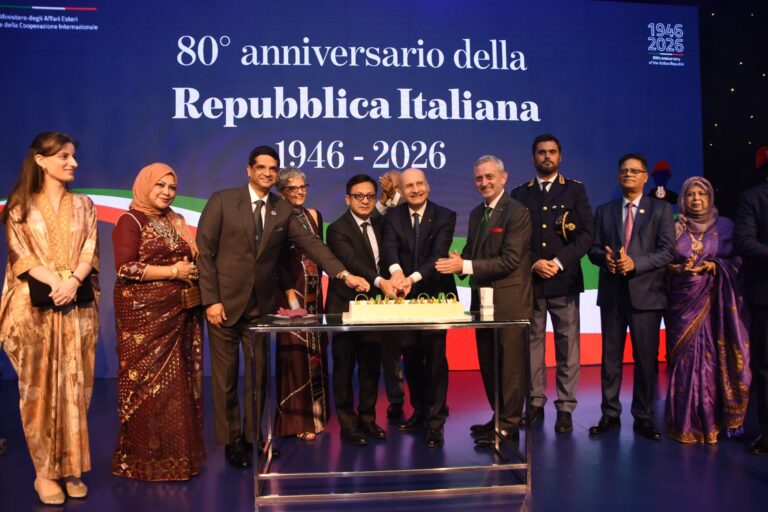
Our excellent bilateral relations were recently reviewed in Rome, in early August, during the third round of political consultations. The review was very positive, with many plans for the future and a very good assessment of the present relationship.
The new government has an ambitious and well-articulated agenda. Italy is, of course, happy to assist within the limits of its possibilities.
We want Bangladesh to develop, to become a full democracy and a modern society. We want to assist Bangladesh in its journey towards democracy, development and modernisation. I can definitely say that Bangladesh can count on Italy as a strong international partner, based on people-to-people bonds and very solid economic relations.
Kaler Kantho: How do you assess the current trade and economic relations between Bangladesh and Italy? Which sectors have investment potential?
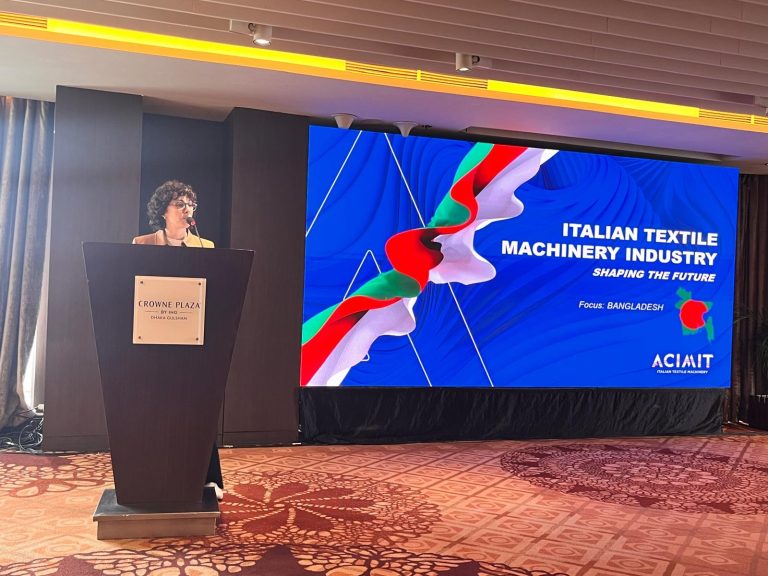
Antonio Alessandro: Our current economic relations are very good. The total volume of trade between the two countries is approximately €2 billion every year. Italy is a large buyer of ready-made garments and other Bangladeshi products. At the same time, Italy is an important supplier of critical industrial machinery and ceramics to Bangladesh.
Of course, we can do better, and we are determined to do better. Many Italian small and medium-sized companies are interested in coming to Bangladesh.
We are launching a new Bangladesh-Italy Chamber of Commerce and Industry. This will certainly help Italian small and medium-sized companies interested in coming to Bangladesh.
We also want to help diversify the Bangladeshi economy. We are already active in traditional sectors such as textiles, leather, ceramics and steel. But we also want to diversify, and new companies are becoming active in other sectors such as design, the creative economy, space technologies, defence technologies and infrastructure. Overall, the relations are very good, and I am sure they will become even better in the future.
Kaler Kantho: What is Italy’s position on future EU-Bangladesh trade relations and a possible FTA after Bangladesh’s LDC graduation?
Antonio Alessandro: As you know, trade policy and trade regulations fall within the exclusive competence of the European Union. Therefore, a future free trade agreement between Bangladesh and the European Union is in the hands of the European Union. But, of course, Italy is very interested. We are following these discussions with great interest and want to contribute to the success of such an FTA.
Signing an FTA with the European Union is a long process. If you look at examples such as Vietnam, Singapore or India, negotiations on such agreements take a long time. In the meantime, it is important to remove non-tariff barriers to our trade relations. Work is already underway with the Ministry of Commerce and Industry, and Italy is involved in and contributing to this effort.
Removing non-tariff barriers is important because they hamper trade flows and also undermine the level playing field that should exist among trading partners. So, in the short term, our main objective is to remove non-tariff barriers in bilateral trade. In the medium and long term, of course, achieving an FTA is the goal. But as I said, this is within the competence of the European Union. We will follow the negotiations and their development and contribute to them.
Kaler Kantho: What is the visa approval and rejection situation for Bangladeshis?
Antonio Alessandro: Long-term work and family visas are based on prior authorisation from the Italian provincial immigration office. Based on these authorisations, we process work and family visa applications.
At present, fresh authorisations issued to Bangladeshi citizens are being processed within a relatively short period of time and good numbers of visas are being issued. Approximately 10,000 work visas were issued in 2025, and we expect a similar number in 2026.
We should also add family reunification visas to this figure because family members can work in Italy once they arrive as family dependants. These family reunification visas are also increasing, with approximately 12,000 to 13,000 being issued every year at present. For fresh authorisations, in recent years we have not had a significant rejection rate. In fact, the rejection rate is very small, and processing times are limited.
The problem we had was with old authorisations. In October 2024, Italy introduced a law suspending these authorisations and visa applications for a number of countries, including Bangladesh, because of irregularities that had been found. As a result, those applications were put on hold for some time and eventually rejected in large numbers.
But this concerns old authorisations and old applications. The new ones are going very well. For short-term visas, such as Schengen visas, particularly for tourism and business, we have a higher rejection rate. This is because many people who attempt to enter Italy illegally through these channels submit fake and forged documents.
Again, we are working very well with the Bangladeshi authorities to prevent the abuse and misuse of public documents.
Both Bangladesh and Italy are parties to the Hague Convention on the recognition of public documents, the Apostille Convention, and we work together to ensure that public documents remain reliable.
The reliability of public documents is very important. It not only affects safe and orderly migration but also the business environment, because investors want certainty regarding the public documents they receive and manage.
This is an important issue. We are working with the Bangladeshi authorities on it. I commend the efforts being made to improve the quality of public documents, and we encourage further progress.
Kaler Kantho: What opportunities are there for Bangladeshi students to study in Italy?
Antonio Alessandro: Last year, we issued 500 study visas. So, 500 talented and genuine Bangladeshi students went to Italy and are now studying at Italian universities. This is very positive. This year, we will probably issue even more study visas.
However, honestly, I do not think it would be sustainable to issue many more visas than this because the number of places available for foreign students at Italian universities is necessarily limited. We have to gradually absorb Bangladeshi students, but we cannot issue an indefinite number of study visas. There is a limit to the number of foreign students that Italy can absorb.
We also support students through scholarships, including Italian scholarships and European scholarships such as Erasmus. We support the arrival of genuine and talented students at our universities, but it has to be within manageable numbers.
As I said, 500 study visas was already a good number last year, and it will probably increase in 2026. There is also a new mechanism in Italy that allows foreign workers to legally enter Italy after completing vocational training in their country of origin before travelling to Italy. Pre-departure training projects are already underway in Bangladesh, and based on this new mechanism, several hundred Bangladeshi workers are now going to Italy legally every year.
Kaler Kantho: Where do you see Bangladesh-Italy cooperation five years from now?
Antonio Alessandro: I see a very bright future. Our people-to-people relations are very strong and our economic connections are growing. Therefore, I see a very bright future for our bilateral relations.
I am sure our partnership will be beneficial to both countries. At the same time, this relationship should not be viewed only as a bilateral relationship; it should also be seen within the broader EU-Bangladesh framework.
We want to continue working with Bangladesh and intensify our connections in all areas. I have already mentioned migration, trade, culture, defence and education. There is a lot of work ahead of us, but we are happy to do it in the interests of both countries.
Kaler Kantho: What is your message to the people of Bangladesh?
Antonio Alessandro: I want to say that the people of Bangladesh have to believe in themselves. You are an extremely resilient, very smart and very active population, and you are also a very young population in a world where demography matters.
I think Bangladesh should be self-confident, and the people of Bangladesh should be more self-confident.
My particular message on migration is: follow the rules. Do not take shortcuts. Do not think that you can avoid the rules simply by paying a false broker.
Follow the rules and consider all options—not only migration, but also investing your future and your talent in Bangladesh, because there are many opportunities in Bangladesh as well. And, of course, Italy stands by Bangladesh. With such a large Bangladeshi community living in Italy, our destinies are somehow interconnected. You can count on Italy for your future, and we will be happy to assist Bangladesh in any possible way.
News link: https://www.kalerkantho.com/feature/last-page/2026/09/09/1736623